Understanding Family Conflict and Finding a Path Toward Healing with Interpersonal Psychiatry
Family is often where we first learn connection, trust, and belonging. It is also where we can experience some of our deepest challenges. When conflict arises within a family, it rarely stays contained—it spreads into daily life, affecting emotional well-being, communication, and even mental health.
Family conflict is not always loud or obvious. Sometimes it looks like tension that lingers beneath conversations. Sometimes it shows up as distance, silence, or misunderstanding that grows over time. And sometimes, it escalates into repeated arguments, hurt feelings, or patterns that feel impossible to break.
No matter how it appears, family conflict can be deeply painful. It can leave individuals feeling unheard, misunderstood, or disconnected from the people they care about most.
But conflict does not mean failure—and it does not mean relationships cannot improve.
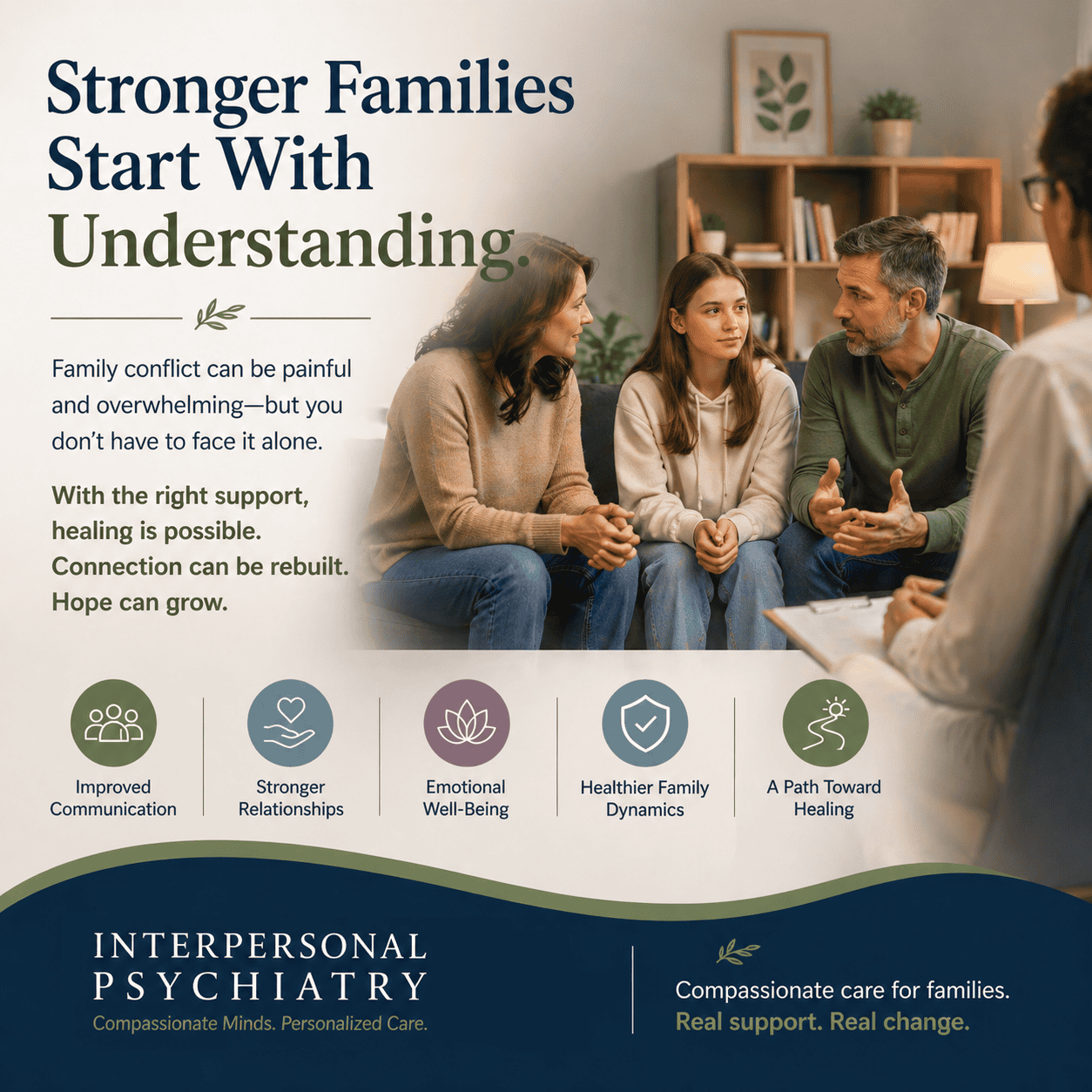
At Interpersonal Psychiatry, family conflict is approached with compassion and clarity. Treatment is not about assigning blame or forcing change. It is about understanding patterns, improving communication, and helping families rebuild connection in a way that feels healthy and sustainable.
If you are navigating family conflict, this guide will help you understand why it happens, how it affects mental health, and how thoughtful, professional care can help create a path forward.
To explore care directly, visit: Family Conflict
What Family Conflict Really Looks Like
Family conflict is often misunderstood as simply arguing or disagreement. In reality, it is more complex.
Conflict can take many forms:
It may be an ongoing tension between parents and children. It may involve siblings who struggle to communicate or feel resentment. It may arise between partners navigating stress, expectations, or life transitions. It may even involve extended family members whose values or perspectives feel difficult to reconcile.
Sometimes conflict is active—arguments, raised voices, or emotional reactions. Other times it is quiet—withdrawal, avoidance, or emotional distance.
In many cases, the most difficult part is not the conflict itself, but the feeling of being stuck in it. The sense that no matter what is said or done, the same patterns repeat.
Family conflict is rarely about one moment. It is about patterns that develop over time.
Why Family Conflict Happens
Every family is made up of individuals with different experiences, personalities, expectations, and emotional needs. Conflict often arises when these differences are not fully understood or communicated.
Life transitions can intensify these dynamics. Changes such as moving, career shifts, parenting challenges, or health issues can create stress that impacts relationships.
Research shows that family dynamics significantly influence emotional well-being and behavior. When those dynamics become strained, conflict can increase and affect mental health outcomes.
In some cases, conflict is tied to deeper patterns—communication styles, unresolved past experiences, or learned behaviors that have carried forward over time.
It is important to understand that conflict is not inherently negative. In fact, when handled well, it can lead to growth and stronger relationships. The challenge arises when conflict becomes repetitive, unresolved, or emotionally harmful.
The Emotional Impact of Family Conflict
Family conflict can affect more than just relationships—it can impact mental and emotional health in meaningful ways.
When conflict is ongoing, it can create:
- Chronic stress
- Anxiety or emotional tension
- Feelings of isolation or disconnection
- Reduced sense of safety or support
Studies show that high levels of family conflict are linked to increased emotional distress and can even contribute to conditions such as depression, particularly when individuals feel unsupported within their family environment.
In families where conflict persists, individuals may begin to withdraw emotionally or physically. Communication becomes more difficult. Trust can erode. And over time, the relationship may feel more strained than supportive.
This is why addressing conflict is not just about improving relationships—it is also about protecting and supporting mental health.
When Conflict Becomes a Pattern
One of the most challenging aspects of family conflict is how easily it can become a pattern.
Arguments may follow the same structure. Misunderstandings may repeat. Emotional reactions may feel automatic.
Over time, these patterns can feel ingrained—as if the family is “stuck” in a cycle that is difficult to break.
Family systems research shows that family behaviors are interconnected. One person’s actions influence another’s responses, creating patterns that reinforce themselves.
This is why resolving family conflict is not about changing one person—it is about understanding the system as a whole.
The Role of Communication in Conflict
Communication is often at the center of family conflict.
Miscommunication, assumptions, and unspoken expectations can all contribute to tension. When individuals feel unheard or misunderstood, frustration builds.
Family therapy research emphasizes that improving communication is one of the most effective ways to reduce conflict and rebuild relationships.
Learning to express thoughts clearly, listen actively, and respond with empathy can transform how families interact.
But communication is not always easy—especially when emotions are involved. That is where professional support can make a meaningful difference.
Why Family Conflict Often Goes Unresolved
Many families try to resolve conflicts on their own, and sometimes that works. But when patterns are deeply rooted, it can be difficult to create change without guidance.
There are several reasons conflict may remain unresolved:
- Avoidance of difficult conversations
- Fear of making things worse
- Long-standing emotional patterns
- Lack of communication tools
- Differences in perspective or expectations
In some cases, individuals may feel that nothing will change, leading them to disengage or accept the conflict as permanent.
But conflict need not remain unresolved. With the right support, change is possible.
A Compassionate Approach to Family Conflict Treatment
At Interpersonal Psychiatry, family conflict is approached with understanding rather than judgment.
Treatment focuses on helping individuals and families:
- Understand underlying patterns
- Improve communication
- Rebuild trust
- Develop healthier ways of interacting
The goal is not to “win” or prove who is right. It is to create a space where each person feels heard, respected, and supported.
Family Therapy: A Path Toward Healing
Family therapy is one of the most effective approaches for addressing conflict.
It is a structured form of psychotherapy that focuses on improving relationships and reducing distress by addressing how family members interact with one another.
Unlike individual therapy, which focuses on one person, family therapy looks at the system as a whole.
Sessions provide a safe environment where individuals can:
- Share their perspectives
- Express emotions openly
- Identify patterns of interaction
- Work toward mutual understanding
Family therapy also helps individuals recognize that conflict is not about blame—it is about dynamics that can be changed.
How Therapy Helps Improve Family Relationships
Therapy provides tools and strategies that can transform how families relate to one another.
This includes:
- Learning effective communication skills
- Developing empathy and understanding
- Identifying triggers and emotional patterns
- Creating healthier boundaries
Research shows that family therapy can help families adapt, grow, and improve their overall functioning by addressing core relational challenges.
Over time, these changes can lead to stronger, more supportive relationships.
Addressing Conflict Holistically
Family conflict does not exist in isolation. It is often connected to broader emotional and environmental factors.
Treatment at Interpersonal Psychiatry takes a holistic approach, considering:
- Individual mental health
- Stress and life circumstances
- Past experiences and trauma
- Relationship dynamics
This comprehensive perspective ensures that care is not just focused on the surface—but addresses the deeper factors contributing to conflict.
Family Conflict and Mental Health Conditions
Family conflict can both contribute to and be influenced by mental health conditions.
Conditions such as anxiety, depression, or bipolar disorder can affect communication, emotional regulation, and stress levels.
At the same time, ongoing conflict can worsen these conditions.
Research highlights that family relationships can either support recovery or contribute to ongoing emotional challenges, depending on how they are managed.
This is why integrated care—addressing both mental health and relationship dynamics—is essential.
The Importance of Early Intervention
The longer the conflict goes unaddressed, the more entrenched it can become.
Early intervention can:
- Prevent patterns from becoming fixed
- Reduce emotional distress
- Improve long-term relationship outcomes
Addressing conflict proactively can lead to healthier communication and a more supportive family environment.
Accessing Family Conflict Treatment in Kansas
Interpersonal Psychiatry offers accessible care for individuals and families across Kansas.
Patients can explore services in:
With both in-person and telehealth options available, care is designed to be flexible and accessible.
What to Expect When Starting Treatment
Beginning therapy for family conflict can feel uncertain, but the process is supportive and collaborative.
Patients can expect:
- A comprehensive evaluation
- A personalized treatment plan
- Guided conversations and strategies
- Ongoing support and adjustment
Therapy moves at a pace that feels comfortable and manageable for everyone involved.
Breaking the Stigma Around Family Therapy
Some families hesitate to seek help because they believe they should be able to resolve issues on their own.
But seeking support is not a sign of failure—it is a step toward growth.
Family therapy is not about assigning blame. It is about creating understanding and building healthier relationships.
Rebuilding Connection and Trust
Conflict can damage trust, but it does not have to define a relationship.
With time, effort, and the right support, families can rebuild connection.
This involves:
- Open communication
- Mutual understanding
- Consistent effort
- Compassion for one another
Healing is not always immediate—but it is possible.
Taking the First Step Toward Resolution
If your family is experiencing conflict, you don’t have to navigate it alone.
Exploring care through Family Conflict
can be the beginning of a new chapter—one built on understanding, communication, and meaningful change.
Final Thoughts
Family relationships are some of the most important—and most complex—connections in our lives.
Conflict is a natural part of those relationships. But when it becomes overwhelming or persistent, it deserves attention and care.
With the right support, families can move from tension to understanding, from frustration to connection.
And sometimes, the most important step is simply being willing to start the conversation.
Because healing within a family is not about perfection—it is about progress, understanding, and the willingness to move forward together.