
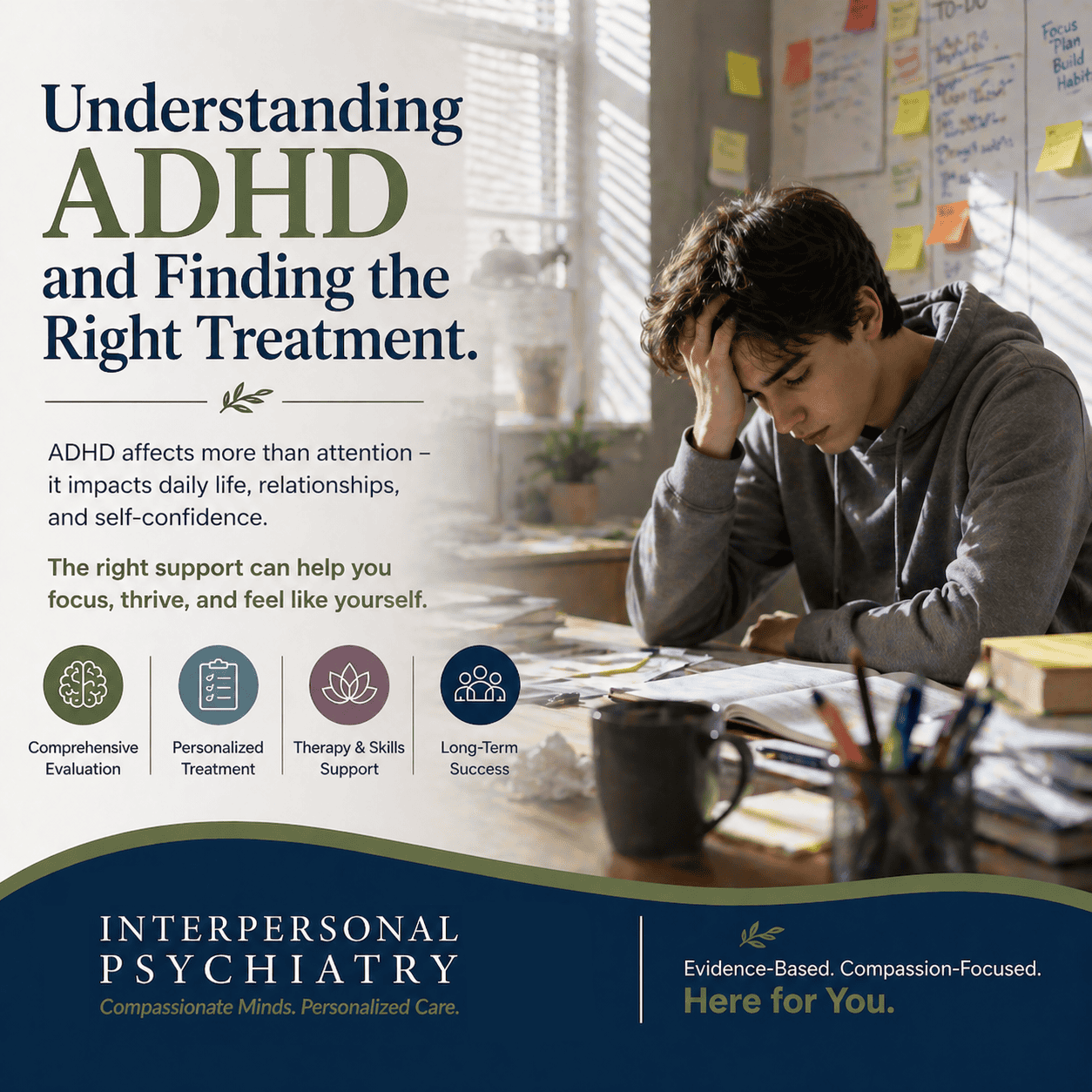
Understanding ADHD and Finding the Right Treatment: A Compassionate Path Forward with Interpersonal Psychiatry
Attention-Deficit/Hyperactivity Disorder (ADHD) is often misunderstood. For many people, it is reduced to stereotypes—difficulty sitting still, trouble paying attention, or being easily distracted. But for those living with ADHD, the reality is far more complex. It can affect how you think, how you feel, how you work, and how you connect with others. It can impact your confidence, your relationships, and your ability to move through everyday life with ease.
At its core, ADHD is not a lack of effort or motivation. It is a neurodevelopmental condition that affects the brain’s ability to regulate attention, impulse control, and executive functioning. And while it can feel overwhelming, the truth is this: with the right support, understanding, and treatment, ADHD can be managed—and individuals can thrive.
At Interpersonal Psychiatry, care is built around this understanding. Treatment is not about forcing people into rigid systems or expecting perfection. It is about meeting individuals where they are, helping them better understand their minds, and building a personalized path forward.
If you are exploring ADHD treatment, whether for yourself or someone you love, this guide will help you understand what ADHD really is, how it affects daily life, and how compassionate, individualized care can make a meaningful difference.
What ADHD Really Looks Like in Everyday Life
ADHD is often described in clinical terms—patterns of inattention, hyperactivity, and impulsivity—but those definitions don’t always capture what it actually feels like to live with it.
For some, ADHD shows up as an ongoing sense of mental clutter. Tasks feel overwhelming, even when they seem simple to others. Starting something can feel impossible, and finishing it can feel even harder. Time slips away without warning. Focus comes and goes unpredictably.
For others, ADHD brings restlessness—both physical and internal. The mind races. Thoughts jump from one idea to another. Sitting still can feel uncomfortable, even when you want to focus.
There are also emotional impacts that are often overlooked. Many individuals with ADHD experience frustration, self-doubt, or a sense that they are “falling behind.” Over time, this can affect confidence and self-esteem.
ADHD is not the same for everyone. Some people struggle more with attention. Others struggle more with impulsivity or hyperactivity. Many experience a combination of symptoms that shift in response to stress, environment, and life circumstances.
Understanding this complexity is essential. Because effective treatment doesn’t just address symptoms—it supports the whole person.
Why ADHD Often Goes Undiagnosed
Many people assume ADHD is something that is always identified in childhood. But in reality, a significant number of individuals go undiagnosed until adolescence or adulthood.
This is especially common in:
- Adults who learned to mask symptoms early in life
- Individuals who performed well academically but struggled internally
- Women and girls, whose symptoms may present differently
- Professionals who appear successful but feel overwhelmed behind the scenes
Without a clear diagnosis, people often blame themselves. They may feel disorganized, lazy, or not trying hard enough. But ADHD is not a character flaw—it is a medical condition.
Getting a proper diagnosis can be life-changing. It provides clarity. It reframes past struggles. And it opens the door to meaningful, targeted treatment.
If you’re wondering whether ADHD could be part of your experience, exploring care through
👉 Understanding ADHD
can be an important first step.
The Importance of a Comprehensive Evaluation
Effective ADHD treatment begins with a thoughtful and thorough evaluation. This is not a quick checklist or a rushed conversation. It is a detailed process designed to understand the full picture of your mental health.
At Interpersonal Psychiatry, evaluations are built around listening—really listening—to your experiences.
This includes:
- Exploring current symptoms and challenges
- Reviewing personal and medical history
- Understanding how ADHD affects your daily life
- Identifying any co-occurring conditions, such as anxiety or depression
ADHD often overlaps with other mental health concerns, which is why careful evaluation is essential. Treating ADHD without recognizing these overlapping factors can lead to incomplete or ineffective care.
A strong evaluation lays the foundation for everything that follows. It ensures that treatment is not just accurate, but truly personalized.
ADHD Treatment: A Personalized and Integrated Approach
There is no single “right” way to treat ADHD. The most effective care plans are individualized, combining different approaches based on each person’s needs.
Research consistently shows that ADHD treatment is most effective when it includes a combination of medication, therapy, and supportive strategies.
At Interpersonal Psychiatry, treatment is designed to be flexible and adaptive. It evolves over time as needs change and progress is made.
Medication Management: Finding Balance and Clarity
For many individuals, medication plays a key role in managing ADHD symptoms. This is not about changing who you are—it is about reducing the barriers that make daily life more difficult.
There are two primary categories of ADHD medications:
- Stimulants, which are typically the first-line treatment
- Non-stimulants, which may be used when stimulants are not appropriate
Stimulant medications, such as those based on methylphenidate or amphetamine, are widely recognized as highly effective for improving focus, attention, and impulse control.
Non-stimulant options, including medications like atomoxetine or guanfacine, offer alternative pathways for treatment and can be effective for certain individuals.
Medication management is not a one-time decision—it is an ongoing process. Providers work closely with patients to:
- Monitor effectiveness
- Adjust dosages
- Manage side effects
- Ensure the best possible outcome
The goal is not perfection. It is an improvement—helping individuals feel more focused, more present, and more in control.
Therapy for ADHD: Building Skills and Confidence
While medication can help regulate attention and focus, therapy addresses the day-to-day challenges of living with ADHD.
Therapy provides tools for:
- Managing time and organization
- Improving emotional regulation
- Reducing overwhelm
- Building healthy routines
Cognitive Behavioral Therapy (CBT) is one of the most commonly used approaches for ADHD. It helps individuals recognize patterns in their thinking and behavior and develop strategies to manage them more effectively.
Behavioral interventions are also proven to play a significant role in improving ADHD outcomes, especially when combined with medication.
At Interpersonal Psychiatry, therapy is not about judgment. It is about support. It is a space where individuals can explore challenges, develop strategies, and build confidence in their ability to navigate life.
ADHD and Co-Occurring Conditions
One of the most important aspects of ADHD treatment is recognizing that it rarely exists in isolation.
Many individuals with ADHD also experience:
- Anxiety
- Depression
- Sleep disturbances
- Stress-related conditions
These co-occurring conditions can complicate symptoms and make ADHD feel more overwhelming.
For example, anxiety can make it harder to focus. Depression can reduce motivation. Sleep issues can worsen attention and memory.
That is why treatment at Interpersonal Psychiatry takes a comprehensive approach. It does not just treat ADHD—it addresses the full spectrum of mental health.
How ADHD Affects Adults Differently
ADHD in adults often looks very different from that in children. Hyperactivity may become less visible, while challenges with focus, organization, and emotional regulation become more prominent.
Adults with ADHD may struggle with:
- Managing responsibilities at work
- Keeping up with schedules and deadlines
- Maintaining relationships
- Handling stress and overwhelm
Many adults feel they are constantly “catching up,” even when they are working hard.
The encouraging news is that treatment works at any age. Standard ADHD care for adults often includes a combination of medication, skills training, and counseling to help manage symptoms and improve daily functioning.
It is never too late to seek help—and it is never too late to feel better.
The Role of Structure, Routine, and Lifestyle Support
In addition to medication and therapy, lifestyle strategies play an important role in ADHD management.
These may include:
- Creating consistent routines
- Using organizational tools
- Breaking tasks into smaller steps
- Building healthy sleep habits
ADHD treatment is not just about what happens in appointments—it is about what happens in everyday life.
At Interpersonal Psychiatry, patients are supported in building systems that work for them—not systems that feel forced or unrealistic.
Accessing ADHD Care in Kansas
Finding the right provider matters. ADHD treatment is most effective when there is trust, consistency, and a strong patient-provider relationship.
Interpersonal Psychiatry offers care across multiple locations, making it easier to access support close to home.
Patients can explore services in:
Local access allows for more consistent care, easier scheduling, and stronger continuity throughout the treatment process.
Breaking the Stigma Around ADHD
One of the biggest barriers to treatment is stigma. Many people hesitate to seek help because they worry about being judged or misunderstood.
But ADHD is not a failure. It is not a lack of discipline. It is a medical condition that deserves care and understanding.
Seeking treatment is not a sign of weakness—it is a step toward clarity, stability, and growth.
What to Expect When Starting Treatment
Beginning ADHD treatment can feel like a big step, but it is often simpler and more supportive than people expect.
The process typically includes:
- A comprehensive evaluation
- A personalized treatment plan
- Ongoing follow-up and adjustments
- Continuous support and guidance
Treatment is collaborative. Patients are active participants in their care, and their experiences and feedback shape the process.
A More Hopeful Way Forward
Living with ADHD can be challenging, but it does not have to define your future.
With the right support, individuals with ADHD can:
- Build stronger focus and organization
- Improve emotional balance
- Strengthen relationships
- Achieve personal and professional goals
Treatment is not about fixing something that is broken. It is about unlocking potential.
Taking the First Step Toward ADHD Treatment
If you have been struggling with focus, organization, or feeling overwhelmed, you are not alone—and help is available.
Exploring ADHD care through
👉 ADHD Treatments
can be the first step toward understanding your experience and finding the support you need.
At Interpersonal Psychiatry, care is built on compassion, respect, and personalization. Every individual is different, and every treatment plan reflects that.
Final Thoughts
ADHD is not a limitation—it is a different way of experiencing the world. With the right treatment, individuals can learn to navigate challenges, build strengths, and create meaningful, fulfilling lives.
Whether you are seeking answers, exploring treatment options, or ready to begin your journey, support is available.
And sometimes, the most powerful step is simply deciding that you don’t have to do it alone.